The Nature of Reality 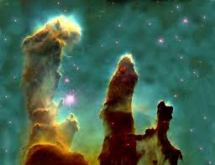
Hanging on a wall in our home, where it can be frequently seen, is a truly stunning photograph taken by The Hubble Space Telescope on April 1, 1995. The image is of the Eagle Nebula, a vast cloud of gas and dust where the matter from burnt-out stars is reorganized into new stars. The Nebula lays some 7,000 light-years distant in the direction of the constellation Serpens. Its three “pillars” are immense- light-years in length, emerging from their “evaporating” tips are gigantic globules of densely packed dust and gas. Relative to the size of the nebula these “embryonic stars” are diminutive, and yet, in reality, they are as wide as our own solar system. The processes involved in condensing this material into a new sun require about one hundred million years to complete.
Everything about the Eagle Nebula; the creation occurring within it, its size, distance from the earth, and the incomprehensible amounts of time involved as it gives birth to stars, all speak of a reality on a scale and of a type none among us can really grasp. It is precisely for this reason I keep its photograph on my office wall. It reminds me that the universe is unimaginably vast, old, and in some ways mysterious. There are forces at work within it that we can’t begin to understand, acting on immeasurable amounts of material and energy that we can’t begin to see (dark matter and dark energy, maybe more about them later), while obeying laws (quantum physics) that seem to conflict with everyday logic, and yet coexist with other laws (Newtonian Physics), upon which our intuitive understanding of the physical world are based. The Eagle Nebula reminds me that there are breathtaking realities that exceed my understanding, imagination, and vision; nevertheless…they are there. The limitations of our unaided senses and reasoning do not form the boundaries of our existence, physical or spiritual. In our day secularism reigns supreme in the media and academia. Many in western culture now belittle the believers, pronouncing the worship of God to be at best a quaint anachronism and at worst a societal danger. If a thing cannot be observed or measured, using whatever tools science possesses at any given point, then it does not exist; never mind, that growth, change, and revision are innate components of the scientific method itself. In short, we don’t know what we don’t know. It is a myopic and foolish creature that contends there is no unknown frontier beyond the horizon.
The question, “what is real” has been asked for millennia by scientists, philosophers, religionists’, and poets. Even the common man (absent of course, as he is of wisdom, intellect, and letters) can’t help wonder. There are those who, after years of exhaustive research, have reached the indisputable conclusion that everything is material (there is rich irony in this statement for Joseph Smith, too, said everything is material, but in a radically different context). There is no mind, only brain. Love, though real enough in its effects, is reducible to the body’s reaction to adrenaline, cortisol, dopamine, and serotonin. Compassion and conscience are merely evolved traits necessary for the survival of our species. Others among us believe that our perceptions of life, and the world around us are all illusions. Nothing is real.
Despite what mystic or materialist may assert, there is more to our reality than can be seen and fully understood through our current faculties. There is a tangible truth that though unseen is not metaphysical. Science itself describes the possibility of a reality far stranger than most of us can imagine. Our basic perception of the universe itself may be woefully incomplete.
“If superstring theory is proven correct, we will be forced to accept that the reality we have known is but a delicate chiffon draped over a thick and richly textured cosmic fabric. Camus’ declaration notwithstanding, determining the number of space dimensions- and, in particular, find that there aren’t just three- would provide far more than a scientifically interesting but ultimately inconsequential detail. The discovery of extra dimensions would show that the entirety of human experience had left us completely unaware of a basic and essential aspect of the universe. It would forcefully argue that even those features of the cosmos that we have thought to be readily accessible to human senses need not be.” Brian Greene, The Fabric of the Cosmos, p. 19
When the proposition of God and all that goes with it seem more like mythology than actuality, I remind myself, of how much I don’t know and don’t see. The existence of the Eagle Nebula, this unimaginably immense and powerful star nursery is a scientific fact, punctuating the blackness of space. Its radiance, having traveled across 7,000 light-years before reaching our night sky is an actuality, whether we acknowledge it or not.* Though I may have difficulty in grasping the tangible existence of the Creator and Ruler of a nearly14 billion-year-old universe; nevertheless…He is there.
* Because of the 7,000 light-years that separate us from the nebula, the “Pillars of Creation” may already be gone. In 2007, scientists using the Spitzer Space Telescope discovered evidence that indicates that the “Pillars” were destroyed by a nearby supernova explosion about 6,000 years ago, but the light showing the new shape of the nebula will not reach the Earth for another millennium.
 A Reason For Faith
You must be logged in to post a comment.