“Reason must be a part of any solution to the mystery of life that we find satisfactory. A supreme deity would no more gift us with intellect and expect us to forsake it in moments of bafflement, than He would fashion us eyes to see and bid us shut them to the stars. Our vision draws us to that which lies beyond our ken- too distant, or too small, for our mortal powers of perception. Yet we do not abandon our gift of sight, but fashion Galileo’s telescope or the electron microscope, which together with the naked eyes unlock new worlds.” Fionna and Terryl Givens
In his book, Temple and Cosmos, scholar Hugh Nibley relates the story of Clement of Rome, (who was in all likelihood the “first of the apostolic fathers.”) From his childhood, Clement was held bound “with chains of care and anxiety” by the existential questions that have troubled so many. These questions have been summarized as “the Terrible Questions”; Where did we come from? Why are we here? Where are we going? (Dr. Nibley’s answers to Clement’s inquiries are fascinating, but I won’t attempt to delve into them here).
Perhaps Nibely and Clement might forgive me if I added to the conversation, questions of doubt, reason, and faith. In the interest of full disclosure: I am not a writer, a scholar, or an academic. I am not educated, well read, or intelligent. I have never held or expect to hold any position of prominence in my church, field of employment, or community. In short, I have only one qualification to address this expanded list of “Terrible Questions.” My single qualification? I have been a doubter, I have sought reason, and I have found faith. I leave it to the reader to determine if there is any measure of truth in what follows, obscured though it would surely be for want of a more skillful advocate. My objective is not necessarily to put forward original thought. Rather, I hope to gather some of the ideas that have helped me negotiate the less than smooth waters of my ongoing conversion. I do so with the full realization that my readers will be few. Perhaps, in some future day, these words will serve to bolster my own faith in a time of trial. Possibly, in some future day a great-grandchild, struggling with similar questions, might stumble across these reflections and find a degree of comfort or direction. That would be my greatest hope, that is why I write.
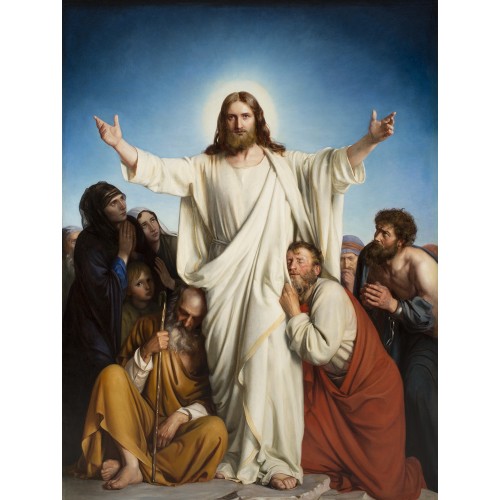
In the “Consolitor,” a painting by Carl Bloch, the risen Christ is touchingly surrounded by a small group of yearning followers. Among those seeking consolation are believers who gaze upon Him with reverence and adoration, cling to Him, rest on Him. To Christ’s side- a man in chains, imprisoned by his own impetuous choices, looks desperately to the Savior for release and relief. And there, in the background, the partially obscured face of the skeptic, the doubter, as he seems to contemplate the meaning of the scene and the Man then before his eyes.
I believe many of us have played each of these roles at different times in our lives. There may be those who, for whatever reason, have a propensity to believe, while others of us struggle with a nature as unrelenting as gravity, constantly pulling us toward questioning and even doubt. Is there a God, if so what is He? Where was He when the unspeakable brutalities of endless war slaughtered the innocent as well as the evil? Was He blind to the suffering of countless children whose sojourn on this earth was so blighted and brief? What of the young father or mother who has been torn from mortality by disease or accident, seemingly without mercy, from a beloved spouse, and children?
And the questions continue: if there is a God, why do many of the most intelligent among us speak so assuredly (with an ever growing contempt of those who dare believe) of the utter meaninglessness of a universe devoid of design or a Creator? Is life itself a miracle or merely the unfathomably fortunate collision of precisely the right materials at precisely the right time?
And still the questions continue, if in a more focused form. Was Joseph Smith a prophet, a charlatan, or a madman? Are the writings he left behind, principle among them the Book of Mormon, the linchpins in a glorious restoration of eternal truth, or Joseph’s own amalgamation of early nineteenth century religious creativity, deception, and folklore?
Of course, there will never be an end to the questions, and they will vary from one person and circumstance to another. Mortality must not be a condition in which we have complete, satisfactory, answers to every spiritual query or intellectual dilemma. Such is the necessary nature of our existence, were it otherwise, Agency and real choice would cease and the Plan of our Father would be frustrated. As Fiona and Terryl Givens have written:
So must reason work with will to fashion understanding. The call to faith is a summons to engage the heart, to attune it to resonate in sympathy with principles and values and ideals that we devoutly hope are true and which we have reasonable but not certain grounds for believing to be true. There must be grounds for doubt as well as belief, in order to render the choice more truly a choice, and therefore the more deliberate, and laden with personal vulnerability and investment. An overwhelming preponderance of evidence on either side would make our choice as meaningless as would a loaded gun pointed at our heads. The option to believe must appear on one’s personal horizon like the fruit of paradise, perched precariously between sets of demands held in dynamic tension.
Resolving all spiritual uncertainty is impossible and to attempt such an undertaking would be foolhardy. Are there genuinely perplexing issues raised by sincere seekers of truth? Certainly- and while ultimately deep and abiding faith is a divine gift, provided through those means He has prescribed, reason need not be abandoned for such faith to take root. It is my opinion that reason is a necessary component of a well grounded testimony, if that testimony is to endure the inevitable “slings and arrows” of an increasingly secular society. The scales of rationality are not heavily unbalanced, favoring disbelief and agnosticism, as some contend. If we are willing to invest the time and effort we will discover that in most circumstances when a weight has been placed on the side of disbelief, another has been placed on the side of belief. While there are questions, there are also answers. When no good answer is immediately forthcoming we can learn to “be still and know that I am God,” trusting that in a future day our knowledge will be made full. There is reason to believe, reason that supports faith and buttresses testimony, reason that gives hope, that can open the door leading to the greater and more sure foundation provided through the Holy Ghost. Like Paul, we may at last reach the ironic conclusion that is both comforting and disquieting- we are “strangers and pilgrims on the earth.” But, we have not been abandoned here, and though a veil provides the temporary separation required for agency’s efficacy, it does not prevent our hearing the divine call beckoning us home.
 A Reason For Faith
You must be logged in to post a comment.